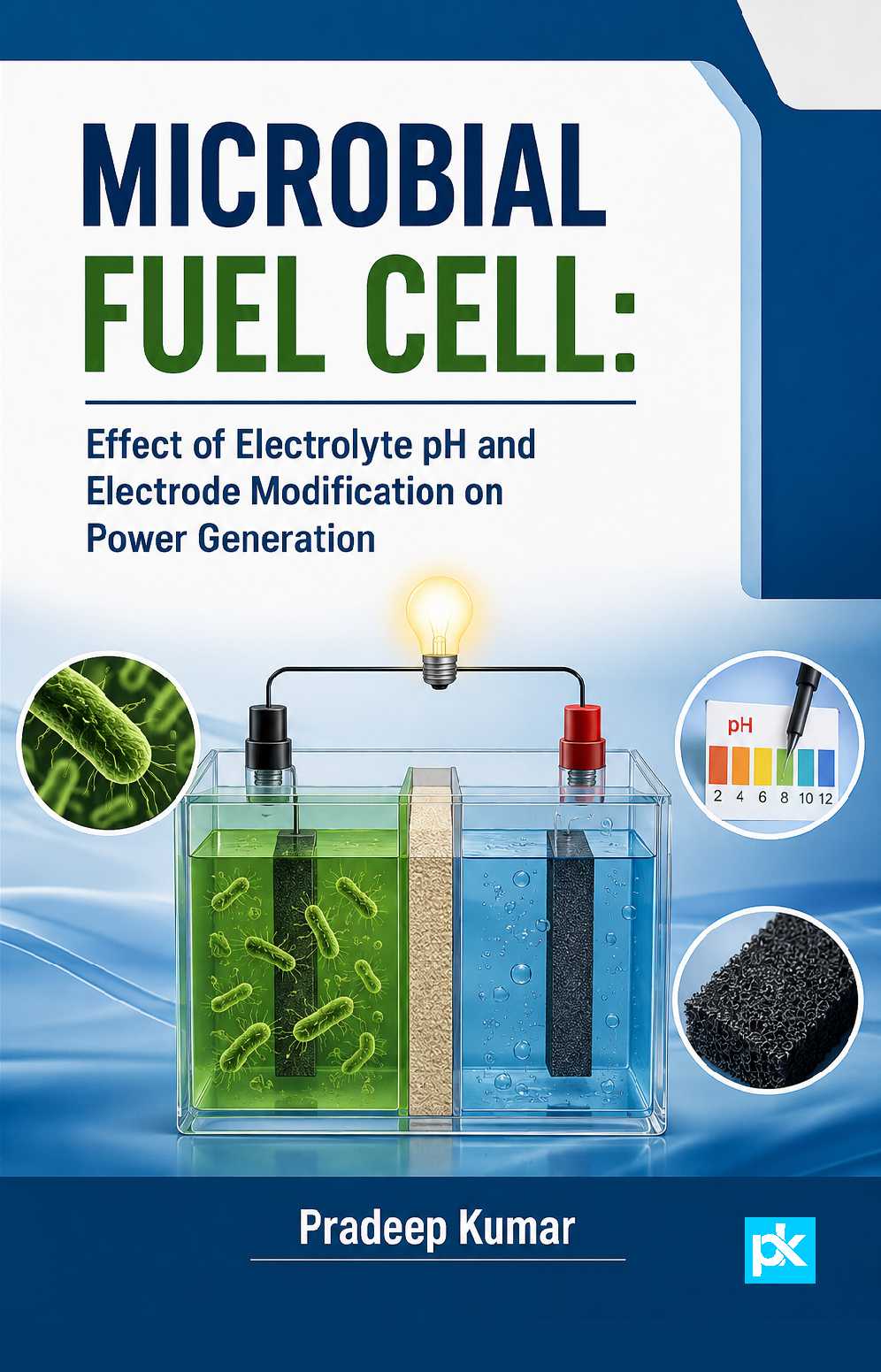
Microbial Fuel Cell: Effect of Electrolyte pH and Electrode Modification on Power Generation

500.00

Contents

LIST OF FIGURES

LIST OF TABLES

1. INTRODUCTION

2. LITERATURE REVIEW

2.1 Microbial Fuel Cell

2.2 Working Principle

2.3 Components and Materials

2.4 Reactor Design

2.4.1 Single chamber MFC systems

2.4.2 Double chamber Microbial Fuel Cell

2.4.3 Multi-chamber/stacked MFC system

2.5 Factors Affecting the Performance

2.5.1 Design factors

2.5.2 Operating factors

2.5.3 Biological factors

2.6 Performance of MFC

2.6.1 Parameters

2.6.2 Electrical parameters

2.7 Mass Transfer

2.8 Various Losses in Microbial Fuel Cell

2.8.1 Activation losses

2.8.2 Ohmic losses

2.8.3 Concentration losses

2.9 Rechargeable Concept

2.9.1 Lithium ion battery

3. MATERIALS AND METHODS

3.1 MFC Configuration

3.2 Pre-treatment: Acid Treatment on Both Anode and Cathode

3.3 Feed Solution and its Analysis

3.4 Calculation for Electrical Performance of MFC

3.5 Electrochemical Analysis

3.5.1 Electrochemical impedance spectroscopy (EIS)

3.5.2 Voltammetry

3.6 Phase 1: Effect of Anolyte and Catholyte pH on Power and its Optimization by Using Taguchi Method

3.6.1 Taguchi method

3.6.2 Analysis of variance (ANOVA)

3.7 Phase 2: Lithium Cobalt oxide (LiCoO₂) as Cathode Electrode Material

3.8 Phase 3: Lithium (Li) Metal as Anode Electrode Material and Lithium Cobalt Oxide (LiCoO₂) as Cathode Electrode Material

3.8.1 Electrolysis of Lithium Chloride in Pyridine (Patten and Mott, 1964)

4. RESULTS AND DISCUSSION

4.1 Start-up Performance Study of Microbial Fuel Cell

4.2 Phase 1: Effect of Anolyte and Catholyte pH on Power and its Optimization by Using Taguchi Method

4.2.1 Effect of Anodic and Cathodic pH on Polarization and Power Density Curves

4.2.2 Effect of anodic pH on percentage COD removal and columbic efficiency

4.2.3 Optimization study

4.3 Phase 2: Lithium Cobalt oxide (LiCoO₂) as Cathode Electrode Material

4.3.1 Electrochemical Impedance Spectroscopy

4.3.2 Cyclic voltammetry

4.4 Phase 3: Lithium (Li) Metal as Anode Electrode Material and Lithium Cobalt Oxide (LiCoO₂) as Cathode Electrode Material

4.4.1 Lithium as an anode electrode material

4.4.2 Rechargeable Microbial Fuel Cell

5. CONCLUSIONS

6. LIMITATION & FUTURE RECOMMENDATION

Limitations

Future Recommendation

References

  • Author: Pradeep Kumar
  • Binding: Hardcover
  • Edition: 2026
  • ISBN: 978-93-47169-38-0
  • Language: English
Category:

Description

About the Book

The growing demand for sustainable energy solutions has encouraged the development of innovative technologies capable of generating clean energy while addressing environmental challenges. Microbial Fuel Cells (MFCs) represent one such promising bio-electrochemical technology that utilizes the metabolic activities of microorganisms to convert organic matter directly into electrical energy. This book, “Microbial Fuel Cell: Effect of Electrolyte pH and Electrode Modification on Power Generation,” provides an in-depth understanding of the key factors influencing MFC performance, with special emphasis on electrolyte pH and electrode modification. The book explores the fundamental principles, operating mechanisms, and performance evaluation of microbial fuel cells. It discusses the role of electrolyte pH in regulating microbial activity, proton transfer, electrochemical reactions, and overall power generation efficiency. The influence of different pH conditions on voltage output, current production, power density, and system stability is presented to highlight the importance of optimization of operating parameters. A major focus of this book is the enhancement of MFC performance through electrode modification. Various approaches for improving electrode conductivity, surface characteristics, microbial adhesion, and electron transfer efficiency are discussed. The relationship between electrode properties and bio-electrochemical performance is explored to provide insights into the development of efficient and durable MFC systems. This book is intended for researchers, students, academicians, and professionals working in renewable energy, environmental biotechnology, and bio-electrochemistry. It offers valuable knowledge on improving microbial fuel cell efficiency and supports future advancements toward sustainable energy generation and wastewater treatment applications.

Reviews

There are no reviews yet.

Be the first to review “Microbial Fuel Cell: Effect of Electrolyte pH and Electrode Modification on Power Generation”